
Supporting guidance for Wader and Wildlife Mown Grassland
Date published: 19 February, 2026
To see recent changes to this guidance, check the bottom of this page.
Introduction
Waders include species such as oystercatcher, lapwing, redshank, curlew and snipe. To survive and breed successfully, they need:
- A safe nesting site. Most waders nest in short or structurally diverse grassland
- An abundance of soil and ground insects
This Wader and Wildlife Mown Grassland option aims to provide safe nesting opportunities for waders in fields closed-off for hay or silage.
Waders need time to incubate their eggs and for their chicks to become mobile enough to avoid mechanical operations such as rolling and mowing. Livestock can also trample and damage nests. Removing stock when the birds are nesting and delaying mowing until the young are mobile will help to increase the breeding success of ground nesting birds.
The exclusion period for the option has been set to take account of the requirements of different wading-bird species.
Note – avoid adopting this option for fields where corn bunting are likely to breed. Corn buntings nest late, laying their first clutches between late-May and mid-June, and their second clutches as late as mid-August. The Corn Bunting Mown Grassland option supports the later cutting dates to accommodate this.
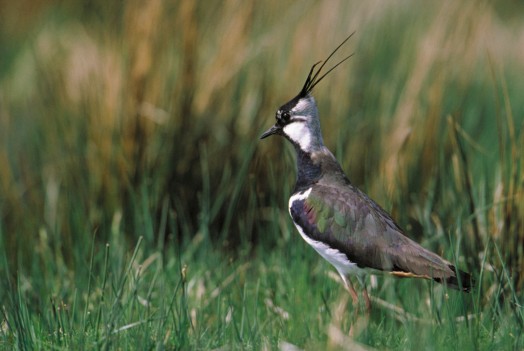
Lapwing – Credit: Andy Hay – © RSPB images
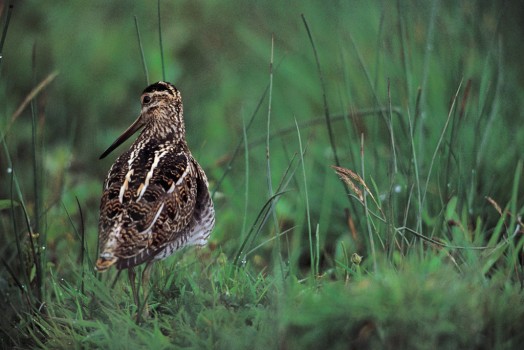
Snipe – Credit: Andy Hay – © RSPB images
What needs to be done
Excluding livestock and avoiding mechanical operations (such as fertiliser spreading, harrowing, rolling and topping) during the breeding season will help improve wader breeding success.
Grazing is required outside the exclusion period to maintain a suitable structure for nesting in the following season.
Research has shown that mowing in a wildlife-friendly manner by leaving a grass strip of two metres around the field provides areas for the birds to escape to around field margins. The uncut and unsprayed field margins will also support larger populations of insects and other invertebrates, which are important food items for wader chicks.
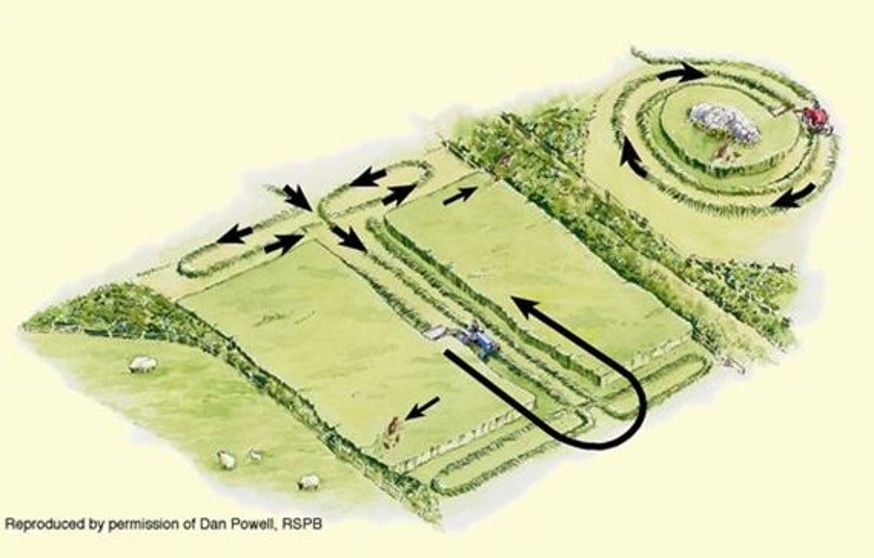
Which fields to choose
Unimproved or semi-improved grasslands are more likely to be selected by waders than improved grasslands. Highly productive rye-grass leys are unlikely to support nesting waders, as the sward grows too high too quickly, therefore, avoid these fields and choose older grass swards.
Fields receiving substantial applications of fertiliser or slurry are unlikely to be suited to this option, as the management required involves late cutting of the crop.
The fields chosen must be established grassland. A spring grass sward does not offer suitable nesting habitat breeding waders. For this reason, fields entered into Wader and Wildlife Mown Grassland management cannot be cultivated after the silage/hay is cut to grow inter fodder crops and then re-seeded. The option can be moved around the farm within the normal rotation and on an annual basis, but the rotation must be included at the time of application.
Research has shown that waders avoid nesting and feeding in areas close to tall trees and hedges. Therefore you should keep the managed area at least 30 metres from any line or group of trees or hedgerows and you should not plant new hedges between fields entered into this management option.
Note on VPS Wader Points:
VPS wader points will only be awarded where the option is located in appropriate locations as described in the supporting guidance for VPS waders. For clarity, we will only award wader VPS points where no land within 30 metres of any scrub, hedgerow, or line/clump of trees is proposed for management.
In any other circumstances, a 30 metre buffer must be left between the scrub, hedgerow, or line/clump of trees and the area proposed for wader management, to enable us to award VPS wader points. You will not be paid management on the buffer area. The 30 metre 'buffer' strips must be clearly shown on your management map with the width labelled.
Fields adjacent to blocks of woodland / plantations should not be included in the application if you want to gain VPS points, even if 30m buffers are included in the proposal.
Fields entered into this option must remain under grass for the full contract, unless you have opted to rotate the option in your application.
Fields can be enhanced for waders by creating wader scrapes to increase insect availability during the summer months. See the Creation of Wader Scrapes capital item for more details.
If you have created wader scrapes then these require to be maintained during the contract period. Further information on maintenance can be found within the supporting guidance for the Creation of Wader Scrapes capital item.
Rushes are a common problem in wet areas and heavy infestations can have an adverse effect on the value of the grassland. Payments are available through capital items for areas needing control. Note, however, that control methods and timing will need to be planned to meet the requirements of the Wader and Wildlife Mown Grassland option.
Further information
Different species of waders on Scottish farms have different management needs, in addition to the manipulation of mowing and grazing regimes. For this reason, implementation of this option alone may not always benefit birds. Therefore, if you are considering this option, we strongly recommend you consider the particular species you intend to manage for, and any additional measures that they may require.
Further advice on four common farmland waders is available on the RSPB website:
Further advice on helping waders on farmland is on the FAS website.
The integration of Wader and Wildlife Mown Grassland with other options, such as Wader Grazed Grassland, and the inclusion of capital items such as Creation of Wader Scrapes and Cutting of Rush Pasture may well be appropriate.
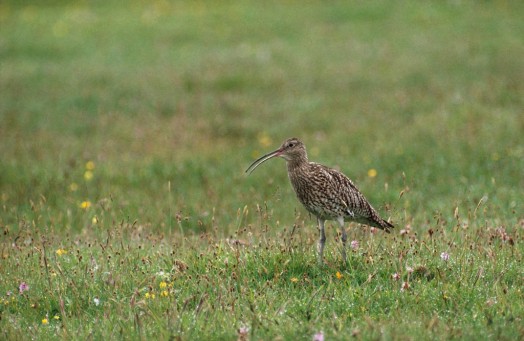
Curlew – Credit: Chris Gomersall – © RSPB images
Getting advice
There are a number of wader-focused projects whose staff will be able to provide advice on waders and their management. To find your local advisor, contact your local NatureScot office.
Recent changes
| Section | Change |
|---|---|
| Note at the top of the page | Removed text. Corrections to links in Further Information section, 31 July, 2023. |
| Further requirements | Correction of broken links to the RPSB pages for Lapwing, Snipe, Redshank and Curlew. |
Previous versions
Download guidance
Click 'Download this page' to create a printer-friendly version of this guidance that you can save or print out.